
BEFORE THE PAN, THE PASTURE.
A chef can do a great deal with a good piece of meat.
Temperature, seasoning, resting, smoke, fire, sauce, technique—all of it matters.
But none of it can improve the life the animal had before it reached the kitchen.
That part of the dish has already happened.
It is one of the reasons we wanted our meat supply to have a clearer story behind it; and why we began working with Great British Meat Co.
FROM THE NORTH EAST
Great British Meat Co. is based in Gateshead, in the North East of England.
Rather than operating simply as a retailer moving packaged meat from one place to another, the company works with farms, cattle markets, and abattoirs in and around the North East; its focus is on British meat, independent farmers, and traditional butchery.
Their philosophy is refreshingly straightforward: know the people supplying the animals, buy well, butcher properly, and allow the quality of the meat to speak for itself.
That fits naturally with the way we approach ingredients at Greek Tings.
A postcode alone does not make something good.
But knowing the region, the supplier, and the chain behind an ingredient gives us considerably more information than simply ordering "beef", "lamb", or "pork" from an anonymous catalogue.
BUTCHERS, NOT JUST BOXES
One of the things that interested us most about Great British Meat Co. is that there are actual butchers behind the business.
The company describes three generations of butchery heritage; its meat is hand-cut to order by its own butchery team rather than arriving as a completely standardised, machine-cut product. Selected meat is matured in its ageing room before being cut, diced, or sliced according to requirement.
That skill matters.
Two cuts from the same animal can behave completely differently. Where a piece of meat is cut, how much connective tissue it contains, how it has been aged, and how it has been trimmed can all determine what we eventually do with it.
A chef and butcher are working on different stages of the same ingredient.
Good butchery gives us something worth cooking.
Our job is not to undo it.
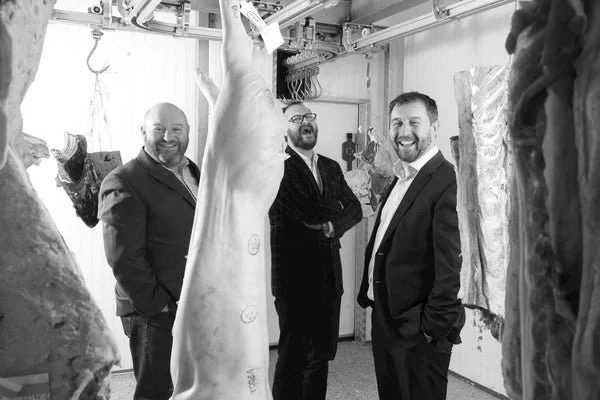
Great British Meat Co. Team | British Meat Supplier for Greek Tings
THE FARMERS BEFORE THE BUTCHERS
The story goes further back again.
Great British Meat Co. works with independent British farmers; the company says its sourcing model prioritises farmers it knows and trusts and aims to reduce the number of middlemen between farm, butcher, and customer.
One farmer highlighted by the company is Alastair Pattinson of Wallhouses, an independent family farm near Hadrian's Wall in Northumberland.
For more than four decades, the farm has reared cattle, poultry, sheep, and lamb; it is precisely the sort of individual farming story that can otherwise disappear once an ingredient simply becomes a line on an invoice.
We are not suggesting that every cut we receive comes from one particular farm.
That would not be honest unless the individual product could be traced that specifically.
What matters is the principle: there are farms and people behind the supply, and the company is prepared to talk about them.
That is a much healthier starting point for traceability.
WELFARE IS PART OF QUALITY
Great British Meat Co. states that its animals are sourced from accredited farms with high welfare standards and slaughtered through approved abattoirs; it also places particular emphasis on supporting independent British farmers.
For us, those considerations are not separate from food quality.
Good farming, responsible husbandry, skilled slaughter, correct ageing, careful butchery, cold-chain handling, and finally cooking are all stages of the same process.
By the time a steak reaches a hot pan or lamb begins several hours of slow cooking, much of the work that determines its quality has already been done.
The chef is simply the final custodian.
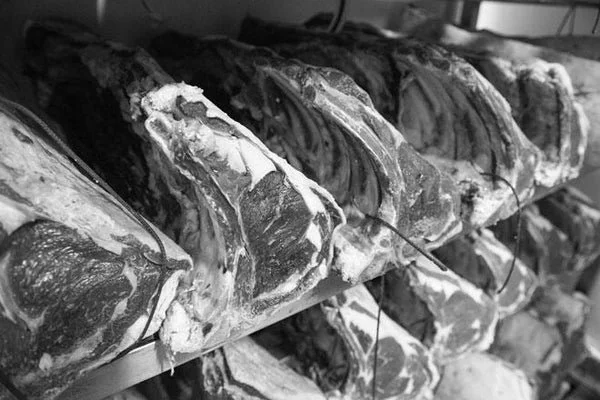
Agin beef from The Great British Meat & Co.
CUT TO ORDER
Freshness is another part of their approach.
Great British Meat Co. says its fresh meat is cut to order shortly before delivery rather than being prepared far in advance; its own butchers then control the final trimming and preparation.
For an events business, that flexibility is valuable.
Our menus can require very different things.
A BBQ might need burgers, sausages, chicken, and large sharing cuts.
A Greek menu could call for lamb suitable for long, slow cooking.
A fine-dining menu may require carefully portioned beef, pork, or lamb where consistency between every guest's plate becomes particularly important.
The product has to fit the cooking method—not the other way around.
WHAT HAPPENS WHEN IT REACHES US
Once the meat reaches Greek Tings, its story becomes our responsibility.
We might marinate it with Greek herbs and olive oil; introduce Jamaican spice and smoke; braise it slowly; cook it over fire; turn it into a croquette; roast it conventionally; or build an entirely modern European plate around it.
Our menus cross cuisines deliberately.
The ingredient underneath them still has to be sound.
Technique can transform flavour and texture, but it should never be used to disguise indifferent produce.
If we are going to spend hours preparing a sauce, controlling a cooking temperature, building a garnish, or allowing meat to rest properly before service, it makes little sense to start with something whose origin and handling we know nothing about.
BRITISH MEAT, WITH PEOPLE BEHIND IT
"British meat" can become just another phrase on a menu.
We would rather understand what sits behind those two words.
Great British Meat Co. gives us a connection to North East butchery, independent farmers, British livestock, and a business that still places value on cutting meat by hand.
That does not mean every ingredient has a perfect, romantic farm-to-table journey.
Real supply chains are more complicated than that.
Traceability is not about pretending otherwise.
It is about knowing more, asking more, and choosing suppliers that are willing to show what happens before their products reach our kitchen.
Because the story of a piece of meat does not begin when the chef turns on the heat.
It begins much earlier.
Before the pan, there was the pasture.
